Lamprohiza splendidula (Linnaeus, 1767)
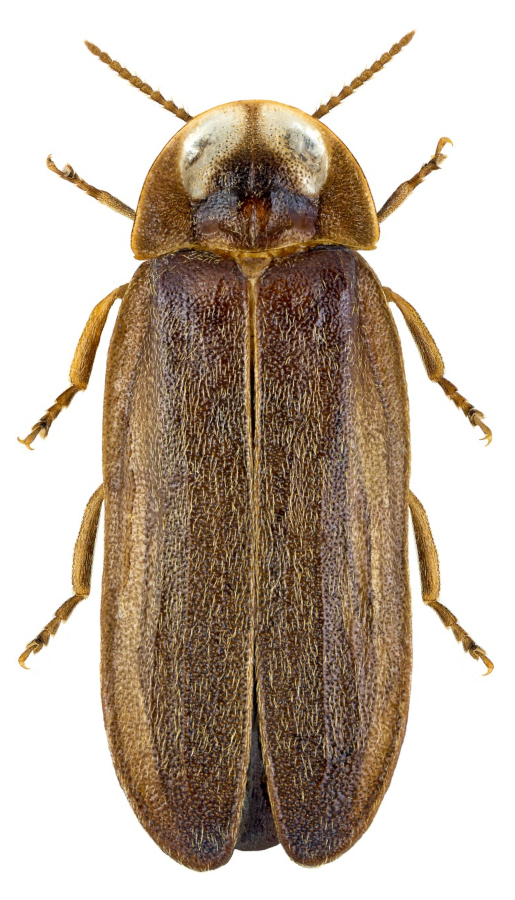 Family: Lampyridae
Males are fully winged and capable of flight. They reach a length of 8–10 mm. They have a flat, brownish-grey body. A distinctive feature is the wide pronotum, which completely covers the head and has two transparent, window-like fields ("fenestrae") in the front, which probably serve to allow the male to see above himself even when his head is hidden. They have large compound eyes. Males have light spots on the 6th and 7th segments of the abdomen (sternite). Females are wingless (larviform) and resemble larvae in body shape. They reach a length of about 11-12 mm. They are yellowish-white to cream-coloured. They have no wing covers or membranous wings (only small rudiments). Females have a much more developed light apparatus, with the entire surface of their abdomen glowing, and they also have point sources of light on the sides of the segments.
The main season occurs around the summer solstice, i.e. from mid-June to mid-July. At that time, we can see glowing males flying around. It prefers moist habitats such as the edges of deciduous forests, bushy slopes, overgrown gardens, copses, banks of streams and rivers, parks and meadows. It is often found near watercourses or in valleys with high air humidity. Its range includes central and southern Europe. The northern border of its range runs through Germany and Poland.
Adult beetles have atrophied mouthparts and consume almost no food. Their sole purpose is reproduction. They survive on reserves they built up in the larval stage. The larvae are predatory. They feed on small terrestrial snails (land snails and slugs). They paralyse their prey with a bite, into which they inject digestive enzymes, and then digest it externally. Larval development usually takes 2 to 3 years.
Image source: Schmidt, 2016